|
Emergency Contingency Procedures ECP Accident Investigation Procedure |
Doc No.: ECP 12-00
Revision: 01 Date: 15 Oct 2024 Issued by: DPA Approved by: MD |
12.1. PURPOSE
This procedure sets out company’s corporate arrangements and procedures for conducting detailed investigations of major incidents and accidents.
12.2. SCOPE
(a) This procedure applies to incidents that may have led to major accidents resulting in injuries, loss of life, damage to property and/or the environment, and breach of any statutory rule or international regulation.
(b) The Top Management shall decide upon the formation of an investigating team led by trained investigators; in-house or sourced from third parties to investigate an accident and to incidents designated as “major”.
(c) Investigating officers or Investigating Teams can be Shore Staff or shipboard staff and will be appointed by DPA and/or Top Management as per the Incident Severity Matrix.
(d) Lead Investigators carrying out investigations must not be connected or have direct interest with the incident or activity leading to the incident.
(e) In addition, they should hold previous experience in Practical Investigation as Assistant or Trainee.
(f) Prior to appointing external investigators, the skill of the personnel to be deployed shall be assessed based on their qualifications, experience, and the type of incident to be investigated.
(g) Trained personnel are given opportunities to participate in investigations and practice the relevant skills before being expected to lead an investigation.
12.3. DEFINITION/ CATEGORIZATION OF INCIDENTS
Accidents/Incidents are classified as per the basis of severity as defined in ECP-12-00B Incident Severity Matrix.
12.4. PURPOSE OF INVESTIGATION
(a) The core process of an investigation shall deal with the following, but not limited to:
• Determine the sequence of events that led to the consequence
• Offer corrective action recommendations to prevent recurrence of the incident
• Never to assign blame or assess liability
(b) All investigations and reporting shall be conducted with the objective of determining the root cause (fact-finding) and shall form an important tool for identifying and controlling potential safety hazards.
(c) The purpose of these activities shall not be to find fault or lay blame, but rather to identify the basic causes of accidents and incidents so that controls can be put in place to prevent further occurrences.
(d) It shall be borne in mind that the biggest mistake an accident investigator can make is jumping to conclusions based on immediate appearances.
(e) A proper investigation must look deeper.
(f) An important consideration in an accident investigation is that an accident rarely has a single "cause".
(g) Most often, an accident is the result of several contributing factors.
(h) All accidents involving personal injury, substantial damage to equipment, shall be reported to the department head and investigated as per the procedure detailed below.
(i) No disciplinary action shall be imposed because of providing information in an investigation, except when there is clear, verifiable evidence of disregard of safety rules/procedures or misrepresentation of facts.
(j) Accident investigations seek to identify the underlying causes that led up to the accident, not just the apparent cause.
(k) Accident investigation procedures are designed to systematically evaluate the role of every possible causation factor.
(l) All types of investigation require clear, concise reporting.
(m) The object of a report is to describe the accident or illness, identify its causes and consequences, and recommend corrective action.
(n) Finally, the effort of an investigation may be wasted if no action is taken on its recommendations.
(o) The investigator shall provide his final report to follow up to see that effective controls have been implemented to prevent a recurrence.
12.5. ESSENTIAL STEPS OF AN INVESTIGATION PROCEDURE
Company has developed an incident investigation procedure which includes in the least the following elements:
- Initial procedures
- The Process of incident investigation
- Close up & Review
12.6. INITIAL PROCEDURES
Soon after a major incident or accident has occurred and after the conduct of first response as outlined in ECP-11-00: Company Response to Shipboard Emergencies, Company management shall initiate the investigation procedures which shall include the following initial steps, but not limited to:
12.6.1. Location of investigation to be conducted
a) The investigation must be conducted at the site of the incident.
b) Initial collection of preliminary facts and essential details shall be done by normal office communication.
c) The Master shall oversee conducting initial investigations and collecting basic facts till the arrival of the investigating team.
d) The vessel PIC shall inform the Master about the plans soon upon a decision is taken in the office.
12.6.2. Persons responsible for conducting the investigation
a) The Team assigned to conduct the investigation shall be decided by the DPA or top management and shall consist of independent investigators who have been trained in such process.
b) If more than one person has been assigned, then the team leader shall be clearly nominated by the DPA or top management.
c) The management shall instruct the Admin group to plan for travel for the investigating team.
d) Important and vital assistance shall be obtained from the shipboard staff including the departmental head, Master and the Safety officer.
e) Investigations require a hands-on approach to ensure that the investigator is thoroughly familiar with all the conditions that contributed to the incident.
12.6.3. The timing of conducting the investigation
a) As far as practical the investigation must be initiated soon after the incident has occurred.
b) This is because memories are fresh, the required evidence is in place and immediate corrective actions can be initiated.
c) The investigation by office staff or any 3rd party appointed by DPA or top management shall commence within 3 days from the date of knowledge of the incident.
d) The 3 days’ limit may be extended due to the exceptional circumstances which are following but not limited to:
i) In case the vessel will depart for the next port before the Investigator reaches the vessel
ii) Non-availability of competent staff at short notice due to some reasons, such as Visa/Immigration issue, etc.
iii) Difficult ports where boarding of Investigator(s) is not practical due to geographical locations or unexpected issues such as injury/sickness or social unrest in the country of arrival.
iv) Other unexpected conditions or situations
e) In case the vessel is at sea, the initial investigation shall be conducted immediately by the Master or any other staff decided by the management.
12.6.4. Immediate data to be secured
a) Master shall check with the office about preserving the data of SVDR/VDR and ECDIS as per the maker’s procedures as soon as possible as some of this data may be overwritten after limited time.
b) Therefore, VDR data must be saved as per instructions from Company’s CART.
c) Master shall also conduct alcohol test of all persons involved within 2 hours of the incident.
d) Master shall also arrange for shore Drug testing of these personnel as may be required for a major incident, within 32 hours of the incident in line with 46 CFR 4.06 & 46 CFR 16.240 unless need to be delayed and unable to conduct due to safety concerns directly related to the incident.
e) In case Master is involved in the incident, company shall instruct other two senior officers to conduct alcohol test within 2 hours of incident and shall arrange for drug testing as may be required for a major incident, within 32 hours of the incident unless need to be delayed and unable to conduct due to safety concerns directly related to the incident.
f) If safety concerns directly related to the incident prevent the alcohol testing from being conducted within 2 hours of the occurrence of the incident, then alcohol testing must be completed as soon as the safety concerns are addressed.
12.6.5. Investigation by Independent 3rd Party
a) Company may consider utilizing the services of independent 3rd party investigators depending upon the kind of accident and geographical area where incident took place.
b) This shall however be decided by top management on case-to-case basis.
12.6.6. Seafarers involved in Accident / Incident
a) At time due to the nature of the accident, the immediate person involved or responsible for the operation resulting in accident on board, may be required for more detailed investigation and / or re-training.
b) Hence in order to have proper investigation in suitable environment, Company may disembark the seafarer(s) directly and / or indirectly involved in the accident from the ship as per the decision of DPA of concerned group.
c) They may be called to one of its Operational and / or Manning offices for a face-to-face discussion and de-briefing.
d) The panel to conduct the discussion and de-briefing for the purpose of the investigation shall be decided by the top management.
12.7. THE PROCESS OF INCIDENT INVESTIGATION
a) Ships installed with the DSM Software shall use M-SCAT methodology for the Root Cause Analysis while carrying out the investigations.
b) It is important to look beyond the immediate and superficial explanations to find the true basic causes of the accident.
c) This doesn’t mean that temporary action should not be taken to remove the immediate hazard.
d) But the investigation should continue until all the contributing factors and the root cause have been identified.
e) As a guideline for investigators, the core process shall normally base upon the following:
- Investigate the facts
- Review the facts to find the cause
- Recommend corrective measures
- Prepare final report and document findings
- Follow-up and review
f) There are several steps that can be taken to ensure that the investigation considers all the possible causes.
g) A systematic approach also ensures that no one else is endangered and that all reporting requirements are met.
h) General guidelines for the investigating team have been enlisted below, however, the team may evolve their best protocol to suit the type of accident.
12.7.1. Investigate the Facts
a) Investigation procedures vary, but there are at least four major steps:
- Look at the situation and secure / manage the accident scene;
- Record general information and fulfill initial reporting requirements;
- Investigate accident causes, collect evidence, interview witnesses;
- Prepare final report and review records
b) Secure and manage the accident scene
i) The priority is to provide first aid or medical response for anyone who was injured in the accident.
ii) The Master or immediate departmental head is responsible for ensuring that the accident scene is secured so that there is no risk of further injury.
iii) Securing the scene also preserves evidence that may be important in the investigation.
iv) If the accident results in a death or critical injury, care should be taken before the scene can be disturbed so that no person may interfere with, disturb, destroy, alter or carry away anything at the scene of, or connected with, the occurrence.
v) There are exceptions for the purpose of saving life, relieving suffering, maintaining an essential operation, or preventing unnecessary damage to equipment or property.
c) Fulfill initial reporting requirements
i) If the accident is major, then Company PIC must be informed immediately.
ii) Company is responsible for contacting the families of injured crew and initiating investigation procedures.
iii) Master shall report accidents and injuries under a variety of circumstances, at the earliest by direct means, but not to hinder any rescue or life-saving operations.
iv) Reporting guidelines as per ECP-09-00 Reporting Procedures.
d) Investigate accident causes
Regardless of any specific system that might be used in a workplace, there are several key steps to an accident investigation.
e) Survey the accident scene
i) The first step is to survey the accident scene.
ii) The investigator should itemize the things that need to be explained and make a list of people who were present at the site of the accident who should be interviewed.
iii) This is the time to take photographs and measurements and write down the immediate facts.
iv) If the accident resulted in critical injuries or fatalities, the accident scene must be preserved as best as possible.
f) Guidance on Investigation Techniques
- There are several techniques that can contribute to an effective investigation.
- They include proven methods for interviewing, analysis, report writing and using information sources.
g) Using Photographs and Drawings
- Photographs of accident or incident scenes are a useful way of recording information.
- They make a permanent record of the location of equipment, tools and other objects in the workplace.
- They can be used later to check details during an analysis, and to illustrate the investigation report.
- Sketches are another way to record information from an accident scene.
- They do not have to be elaborate. They have the advantage that they focus only on the elements relevant to the accident.
- They can be helpful when interviewing witnesses and performing an analysis.
- Sometimes, more detailed drawings are required.
- It may be necessary to record the exact distances involved. In this case, the drawing can be made to a precise scale and drawn on graph paper.
- Each object should be measured from at least two reference points to verify the accuracy of the drawing.
h) Interview witnesses
- Individually
- At the scene of the incident
- Immediately after the incident, if possible
- With an open mind
i) Guidance on Conducting Interviews
i) The purpose of conducting interviews is to find out what the person knows about an accident or about possible causes.
ii) The interview may also identify additional people to be interviewed.
iii) Interviews should be conducted as soon as possible after the accident. Interviewers should be courteous and try to put the person at ease.
iv) They should explain that the purpose of the interview is to prevent a recurrence and avoid any suggestion that blame is being assigned.
v) Interviews should be conducted separately and privately, so that people are not influenced or intimidated by the presence of others.
vi) Interview questions should be simple and to the point.
vii) Ask the person to explain what happened, or what they know about the possible causes of the accident or illness.
viii) Don’t ask questions that suggest the answer. Don’t tell the person what the answer should be or what may be expected. Don’t interrupt. Instead, ask clarifying questions later.
ix) Try to avoid questions that invite a "yes" or a "no" answer.
x) Make careful notes during the interview and, if necessary, ask the person to repeat their answer to ensure accuracy.
xi) At the end of the interview, review the key points and confirm that they are accurate.
xii) If the interview is conducted at the worksite, the person may be able to point out relevant objects. Otherwise, diagrams or photographs may be used.
xiii) At the end of the interview, arrange to stay in contact in case the person remembers additional details later.
xiv) Thank them for their help and let them know that they have helped to prevent a recurrence.
xv) Everyone who has information relevant to the investigation should be interviewed.
xvi) This includes eyewitnesses, workers on other related tasks or work shifts, technical experts and, sometimes, equipment designers or suppliers.
xvii) Eyewitnesses should be interviewed first, while the details are still fresh in their minds. Detailed notes should be kept for later analysis.
h) Physical Investigation
Physical evidence shall be collected and includes but is not limited to:
- Documentation for Class, if available
- Service Engineer’s report where available
- SVDR/VDR data
- ECDIS data
- Flag or any other authority reports
- Bulleting/Alert/Notices sent to the fleet/vessel during this time
- Copies of Navigational Charts
- Copies of Logbooks
- Crew Experience Matrix during the incident
- Officers & Crew Statement
- Statement of any 3rd party if available
- Crew Work & Rest Hour Records
- Details of equipment damage
- Breaks, rips, etc.
- Burned materials
- Skid marks
- Signs of impact, etc.
- Photographs and diagrams or measurements
- Details of the work environment, such as visibility, noise level, temperature, and exposure to hazardous materials
- Samples of chemicals
- Broken parts or pieces
At this stage, documents such as equipment specifications, maintenance schedules and work procedures may also be considered.
12.7.2. Review and analysis of the facts
a) Analysis is an organized method of solving a problem by breaking it down into its constituent parts.
b) The immediate "cause" of the accident may already be apparent. The purpose of an analysis is to find all the contributing factors.
c) An analysis systematically reviews all the factors that could contribute to an accident.
d) There are several ways of classifying the factors that can contribute to an accident. For example:
- human factors;
- material factors;
- equipment factors;
- environmental factors;
- process factors.
e) Each factor must be carefully checked against the facts to see if it could have played a role in the accident.
f) This is easier to do if the facts are first grouped into categories. For example, an investigation might have assembled the statements of witnesses, photographs, physical evidence, and written evidence such as work procedures.
g) When all the factors that might have contributed to the accident have been identified, the sequence of events can be reconstructed.
h) At each step, the suspected cause can be checked against the facts.
i) Organize the Facts
- All information should be organized and subjected to a thorough analysis. Where possible, separate facts from opinions.
- Identify gaps in the information and re-interview witnesses and confirm facts.
j) Look at the situation
- Examine the big picture
- Think of the 5 W’s (who, what, why, when, where) and How?
- Outline the approach
- Examine events that occurred before, during, and after the incident.
- Don’t be quick to start filling out forms. Take some time to think about how to approach the investigation.
12.7.3. Recommend Corrective Actions
- (a) The investigator shall review the facts to find the Root Causes.
- (b) This process is very important and is judged solely based on fact finding by the investigators.
- (c) Such recommendations shall be forwarded to Company management initially and then formalized in the final report.
- (d) The sequential steps may be as per below:
- Review all information
- Look at each step in the chain of events
- Clarify the facts
- Analyze information
- Examine contributing factors
- List possible causes
- Identify the cause
- Take extreme care not to jump to conclusions
- Suggest attainable actions
- Start with simple solutions; move on to those that will be more complex
- Assign responsibility for implementation
- Coordinate a schedule for implementation
- (e) These corrective actions shall be further discussed by the management to ensure that there is general understanding and consensus on suggested measures and that sufficient resources and procedural guidance has been made available by the management.
12.7.4. Prepare the Report
- (a) The Lead investigator shall prepare the final investigation report which should explain the circumstances of the accident, identify the primary and secondary causes and recommend controls to prevent a recurrence.
- (b) The report should be submitted to Company Top and senior management.
- (c) The investigator should follow up later to make sure that the recommended controls have been put in place.
- (d) These reports shall be kept and maintained by each Group for a period of at least ten (10) years.
- (e) Guidance on Report Writing
- (i) If a comprehensive report is prepared, it should be clear, concise and logical. Its purpose is to identify the causes of the accident and make recommendations for remedial action.
- (ii) A typical Incident investigation reports might be organized as follows:
- General information
- Description of the accident
- Description of injury
- The consequences
- Analysis and the causes
- Corrective actions taken
- Recommendations for further action
- Dates for completion
- (f) A report may be illustrated with photographs or diagrams or supporting documents.
- (g) The report should not contain the opinion of the writer or anyone else if it is not substantiated.
- (h) If some points are unexplained, there should not be any attempt to answer them hypothetically.
- (i) All reported incidents / accidents are to be investigated for root cause through Tech deficiency List/DSM defect reporting module.
- (j) PIC may ask for Root Cause Analysis (ECP-12-00D / ECP-12-00E MSCAT) for any reported incident through Defect reporting system/DSM defect reporting module.
- (k) Investigation Report by office investigator shall be made on “ECP-12-00A Incident Investigation Report by Office” and all supporting documents such as photographs, ship’s reports etc. shall be produced together.
12.8. CLOSE-UP AND REVIEW
- (a) The accident report shall include recommendations to management for controls to prevent a recurrence.
- (b) There shall be an SMC meeting to review the investigation to ensure that senior management has discussed the contents of the report, including a detailed discussion on the Root Cause and that effective action has been taken to implement the recommended controls.
- (c) The follow up by management shall ensure that recommended corrective actions
- Have been implemented properly
- Are effective in eliminating or reducing future incidents
- Do not create an unforeseen hazard
- (d) Investigation shall be concluded within 3 months of the date of incident.
- (e) Recommendations concluded in the investigation shall be implemented within 3 months from the date of conclusion of review meeting or as decided in SMC unless of urgent nature which is to be implemented asap.
- (f) Recommendations related to structural or machinery/ equipment design may be deferred to next dry dock of the vessel, if so required.
- (g) It is important that all Findings and Actions are documented, and distributed to concerned parties as decided by the management.
12.9. ASSESSING ACCIDENT TRENDS
- (a) The management shall also review records to identify trends
- Inspection records
- Previous incident reports
- Maintenance records
- (b) In order to maintain a record regular statistic of accidents, such reports can be classified according to several factors.
- (c) It is then possible to detect patterns or trends in the data.
- (d) The usefulness of this type of data depends on how well it is classified. For example, one classification for accidents might be "falls".
- (e) A pattern of falls in the workplace could trigger further investigations. But if the data allowed a segregation of "falls from ladders", for example, the nature of the underlying problem would be more apparent.
12.10. INCIDENT INVESTIGATOR TRAINING
- (a) As a commitment to ensure systematic and effective investigation it is essential that proper a training program is executed, and enough senior management staff are available to conduct such investigations in the most rational, logical and effective manner.
- (b) There shall be specific components of this training program which may be conducted as per industry standards.
- (c) Internal training process shall also be implemented so that junior staff can benefit from the external training.
- (d) Hands on exercises and training shall be provided to investigators before they proceed to conduct a major investigation.
- (e) The trainee investigator shall attend and assist in at least one major accident investigation before being assigned with an independent investigation.
- (f) Proper documentation of such training shall be maintained as per company procedure.
- (g) Training topics shall be but not limited to:
- How to conduct an incident investigation
- Finding the facts and not place blame
- Finding the root cause of an incident
- Complete an incident investigation report
- Set up procedures to prevent re-occurrence
- (h) Refresher training related to accident investigation procedure shall be conducted at an interval of at least five (5) years to key personnel assigned with this responsibility.
12.11. SHARING OF INFORMATION
- (a) As per Company procedure, the COO/President shall assess the significance of an accident and provide appropriate notification to external parties.
- (b) Such information shall be shared with industry as well Oil Majors, as decided by the management.
- (c) It shall be recorded and followed up through the Incident Tracking Log in office.
- (d) All Incidents involving Oil pollution, Collisions, contact damages, Fires onboard and PSC detention shall be shared with Oil Majors and Time Charterers on case-to-case basis, as decided by management, using either OCIMF VIR platform and / OR by email to designated email ids.
- (e) In case of informing Oil Majors by email, Owners to be consulted for which Oil Major companies to be notified.
- (f) All applicable KPI benchmarks of the fleet shall be benchmarked at BIMCO or any other platforms where available.
12.12. GUIDELINES TO MASTER AND HIS ROLE
The master shall extend all co-operations to the investigating team and shall refer to the relevant industry and ICS publication in order to seek appropriate guidance for this process.
12.13. ROOT CAUSE ANALYSIS OF INCIDENTS
12.13.1. Responsibility
- (a) The Master and Chief Engineer are responsible for examining the nature of non-Conformities, accidents, near misses and other deficiencies noted during shipboard Inspections.
- (b) The Master and Chief Engineer assisted by Chief Officer/ 1st Engineer shall collect all relevant information and make their initial assessment.
- (c) Such information shall be presented to the company.
12.13.2. The Accident Sequence
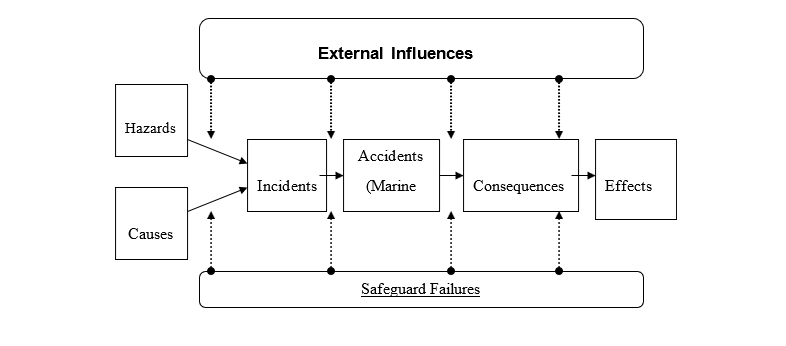
- (a) Marine casualties usually occur through a chain of events ending in one or more unwanted effects.
- (b) This chain of events begins with hazards capable of causing casualties. If there are no hazards, there are no casualties.
- (c) An equipment failure, human error, or external event is necessary for a hazard to cause an accident (i.e., a marine casualty). This initiating event is an incident.
- (d) Sometimes one or more equipment failures, human errors, or external events must take place after the initial incident (i.e., the initiating event) for an accident to occur.
- (e) An accident has at least one unwanted consequence with a measurable effect.
- (f) This outcome is influenced throughout the chain of events by the presence of safeguards and their success or failure.
- (g) Causes are the underlying reasons why the initial incident occurs and safeguard failures allow the chain of events to progress. These are sometimes also called root causes of the accident.
- (h) Combinations of equipment failure and human error cause marine casualties.
- (i) Sometimes the underlying causes result from personal performance errors; that is, all practical measures for preventing the errors had been tried.
- (j) Humans will eventually make mistakes with even the most error-proofed systems.
- (k) However, the underlying causes can usually be traced to weaknesses in an organization's management systems; that is, its programs and policies.
- (l) Weaknesses lead to conditions for equipment failure and error-likely situations for individuals. These are the underlying root causes of most marine casualties.
12.13.3. What is a root cause?
- (a) Root causes are the most basic causes of an event that meet the following conditions:
- They can be reasonably identified
- Management has the ability to fix or influence them
- (b) Typically, root causes are the absence, neglect, or deficiencies of management systems that control human actions and equipment performance.
- (c) For any event leading to a marine casualty, there may be more than one underlying root cause.
- (d) If these root causes are not found and corrected, the underlying management system weaknesses will lead to marine casualties.
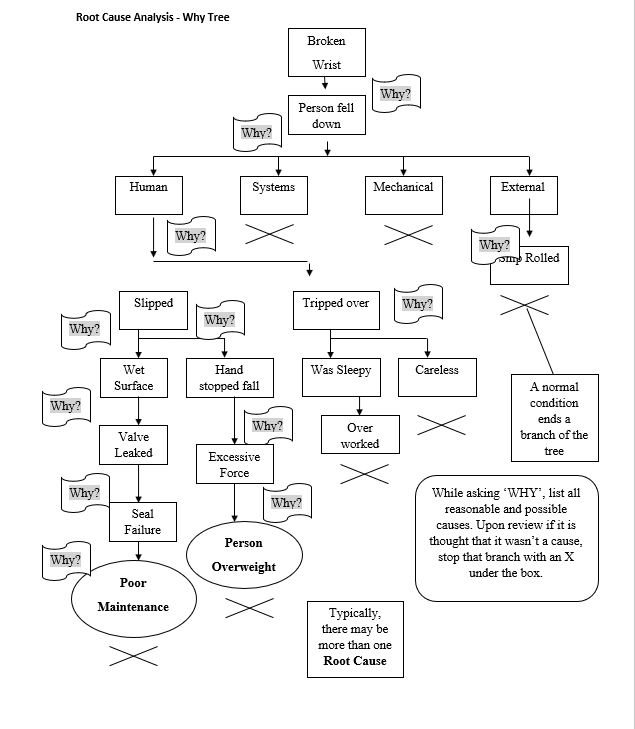
| Effects | Action | Causes |
|---|---|---|
| 1. Injury | → | Fall |
| 2. Fall | → | Wet surface |
| 3. Wet surface | → | Leaky valve |
| 4. Leaky valve | → | Seal failure |
| 5. Seal failure | → | Not maintained |
(e) Please note that Remedial action is ‘an immediate measure taken to rectify the deficiency’ but does not mean that a Corrective action has been enforced.
(f) Corrective action shall be the action derived upon completing an investigation report, finding the root cause and then taking measures to prevent re-occurrence.
Root Cause Analysis - Why Tree
12.14. DEFINITION FOR REASON CATEGORIZATION OF INCIDENT
- (a) Maintenance / Management Deficiency: Factors which results from lack of maintenance or improper Management. Defect, imperfection or lack of maintenance management and preservation.
- (b) Improper handling: Factors which results from improper operation. This is un-intentional non- follow up of the procedures.
- (c) Lack of Knowledge: Factors which results from worker’s lack of understanding of the company/ maker’s instructions or procedures. It is un-intentional non follow up of the procedure.
- (d) Negligence: Factors which results due to lack of attention. It is the intentional non follow up of the procedure.
- (e) Design Deficiency: Factors which results due to machinery, equipment or instruments design failure. Incident due to defect, lacking and insufficient structure or design.
- (f) Material Process/Quality: Factors which results from quality of the spare parts used or material failure of the equipment due to poor quality. Defect of quality / Incident due to defect of production.
- (g) Others: Other than above items. Incident which occurred although enough preventive measures have been taken and enough attention have been paid and cannot be categorized in any of the above categories.
Note: Vessels with DSM installed on board to use M-SCAT methodology which is configured for all the modules to carry out the root cause analysis instead of the WHY tree.
Ref: Investigator Log Incident Tracking Log (for Office)
App: ECP-12-00A Incident Investigation Report by office ECP-12-00B Incident Severity Matrix ECP-12-00C Incident Investigation & Analysis Report by ship ECP-12-00E M-SCAT 8.2 (Marine Systematic Cause Analysis Technique)
-x-